


What if Africa’s greatest untapped resource isn’t its minerals or land, but its knowledge? Every year, thousands of studies are produced across the continent yet too many never reach the policymakers, businesses, or communities they were meant to serve. At a time when Africa faces rapid technological change and complex social challenges, the stakes are high. The question is clear: will research remain locked in silos, or can it become the driver of real transformation in development, policy, and society?
From knowledge to action
African scholarship has never lacked depth. What it has lacked is influence. Too many studies gather dust unpublished, inaccessible, or written in language that makes them impenetrable to non-academics. Closing this gap means focusing on research translation which means turning findings into strategies that governments, businesses, and civil society can use. Research must be judged not only by the questions it asks, but by the solutions it sparks.
Technology rewriting the rules
Artificial Intelligence (AI), big data, and digital platforms are shaking up the research landscape. They offer African scholars the power to crunch massive datasets, forecast trends, and present evidence in fresh, interactive ways. They also enable collaboration across borders like never before. But this power comes with responsibility. Without ethical frameworks to protect inclusivity, privacy, and equity, technology risks reinforcing the very inequalities it seeks to address.
Whose knowledge counts?
For research to truly serve Africa, it must be inclusive both in who conducts it and who benefits from it. Young people and marginalised communities should not only be research subjects, but active partners in shaping agendas. Equally important is recognising the value of indigenous knowledge. Blending traditional wisdom with scientific inquiry can create solutions that are both locally grounded and globally competitive.
Making impact the new standard
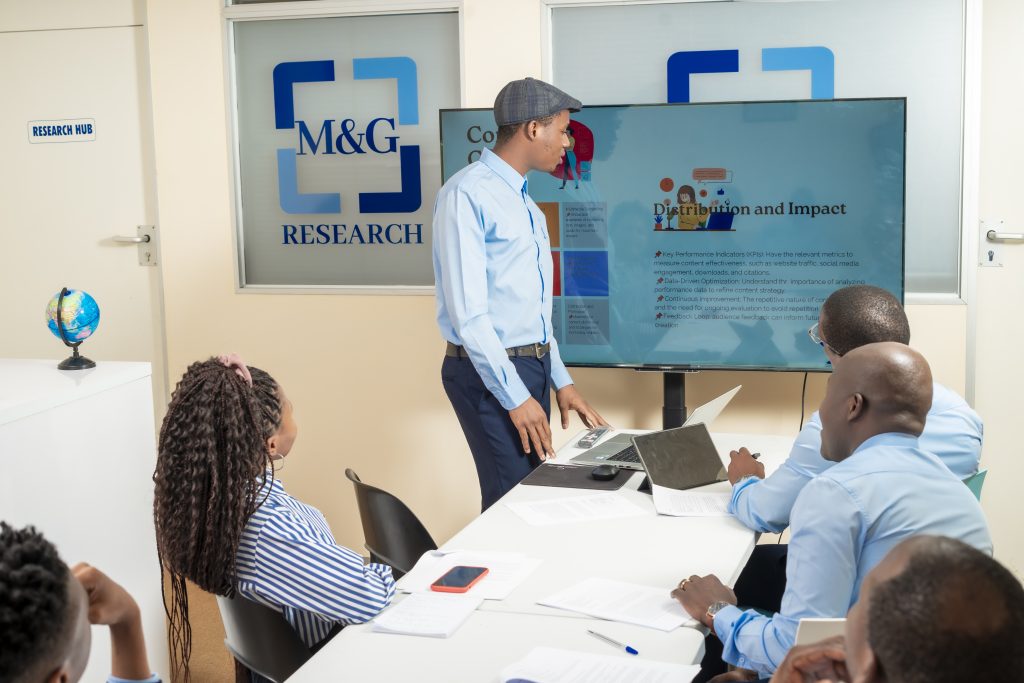
The ultimate test of research lies in its ability to inform policies, strengthen institutions, and improve daily life. That means building stronger bridges between universities, governments, and the private sector. It also means ditching jargon-heavy outputs in favour of formats that resonate with decision-makers and communities alike.
Dr Gilbert , Senior Executive Researcher at M&G Research, explains:
“The strength of African research lies in its ability to influence transformation beyond the academic sphere. Our projects from municipal governance studies to education and labour market research show that evidence-based strategies can provide lasting solutions to structural challenges. The future of research is not in isolated reports, but in building a knowledge culture that changes lives.”
Dr Tigere Muringa, Research Director, adds:
“Research must be dynamic, forward-looking, and impact-driven. By embracing AI-powered analytics, predictive modelling, and strategic advisory, we are positioning African research at the heart of global conversations. Every piece of knowledge we generate should translate into sustainable development, equitable opportunities, and institutional resilience across the continent.”
At its best, research does more than generate knowledge it fuels transformation. Africa’s future depends on building a culture of research that is bold, inclusive, and impact-driven.
At M&G Research, we are committed to shaping research that matters. Reach out to us for collaborations, workshops, or tailored support that transforms ideas into impact.
📞 Call us: +27 (031) 065 1929
📍 Location: 17 Lennox Road, Windermere, Durban
🌐 Website: https://mgresearch.co.za/




Leave a Reply